Written by Olivia Haney
At 22, Dylan Pitanza has already curated an impressive resume across stage and screen, from appearances on FBI (CBS) to founding his own production company, Utopia for Losers. With his company, he has directed, produced, and performed in revivals of María Irene Fornés’ Mud, John Patrick Shanley’s Welcome to the Moon, and Neil Labute’s Reasons to be Pretty over the past three years. Now Pitanza, an alumnus of LSTFI’s Young Actors Program and One-Year Conservatory, has a series of exciting projects releasing this summer. He was most recently seen in AppleTV’s Your Friends and Neighbors, and will be featured in Netflix’s Don’t Say Good Luck, premiering on August 14th.
A Dark New Romance Hits the NYC Stage
In addition to his upcoming film projects and work on existing material, Pitanza is now tackling one of his most rewarding roles to date. The LSTFI alum has teamed up with a group of young artists, including Christopher Paul Richards (The Kids Are Alright, Goosebumps), Chloe Margot (Expensive Imagination), and Malina Weissman (A Series Of Unfortunate Events, Coven Academy) to bring New York’s newest teenage romance to the stage.
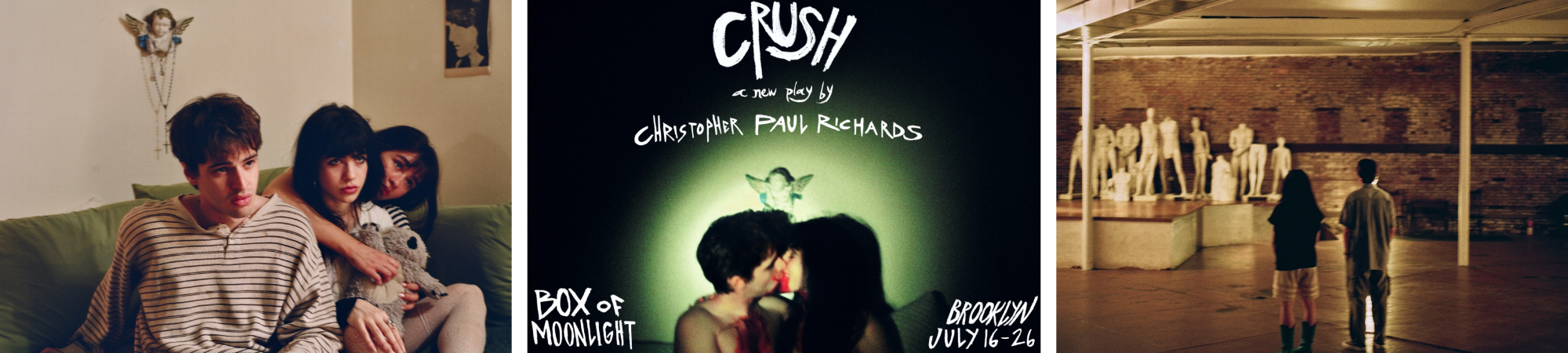
Following a staged reading at TheaterLab earlier this year, and a run at the New York Theater Festival this past June, Pitanza is producing and starring in Crush, a new play by Christopher Paul Richards, at The Box of Moonlight from July 16–26.
Crush follows teenagers Billie and Cherry, whose first date ends in a charged sexual interaction that leaves them both unraveling into a period of self-reflection, doubt, and reckoning.
“They have this moment of intimacy and vulnerability off of a one-night stand, and it ends up being kind of bloody,” Pitanza explains. When Billie and Cherry run into one another by chance months later, the two are forced to reckon with the incident, and what it meant to them in conjunction with their relationship to identity, trauma, and shame. What follows is an explosive confrontation between the two that unearths truths, where violence meets intoxicating desire, confession meets guilt, and isolation meets a raw longing for connection.
“It’s really a play about trying to understand those deeper, darker corners of yourself,” Pitanza went on to say. Growing up in a generation that has inherited a world inundated with isolation and disconnect through a global pandemic, social media, and the rise of AI, Pitanza says the most rewarding part of the process has been offering audiences a space to experience vulnerability and the perspectives of young artists.
“I think people in Gen Z have all of the knowledge and self-awareness of all the things they’ve been through—all the pain, all the trauma they’ve experienced—but they don’t always have the bandwidth to communicate exactly how they feel,” Pitanza says on how Crush relates to a generation that has been habitually undermined and told to make themselves into a more palatable version of themselves.
“For me, it feels like an act of pure rebellion,” Pitanza says of putting up independent theater. “I think theater is resistance, and art is resistance.
The production’s online presence captures this same rebellious energy, and the show’s grungy downtown aesthetic. When visiting @crushplaynyc, you’re met with images of the play’s young stars, stylishly drenched in blood across the landscape of New York City.
Finding Himself Through Cherry
Pitanza, who originated the role of Cherry, has gotten to grow with the role across the play’s initial workshop, reading, and subsequent runs. In turn, he has reflected on how the process has contributed to his development as an artist and taken him on a journey of self-discovery.
“The play has given me a newfound love for all of the parts of myself that I used to try to shy away from,” the actor shares. Cherry, a teenager with a tendency to bottle up his emotions, has provided Pitanza the opportunity to explore the uglier sides of a character and how they relate to his own experiences as a young person.
In Cherry’s case, that emotional repression yields devastating consequences, serving as a cautionary tale about the harm that can be done when trauma goes overlooked. By playing a character so tethered to vulnerability, Pitanza says the experience has made him more vulnerable with himself.
“I have found throughout the process that it just keeps becoming more and more personal to me. I dive deeper into Cherry, and I think I’m learning more and more about myself,” Pitanza shares of diving into this role, and how the process has encouraged his own period of healing.
“I’m experiencing something really unique—being able to provide a story that is not far from my own personal experience and being able to be vulnerable in a way that is very truthful to me,” Pitanza says. In presenting this play, he hopes that other young people may be inspired to share their own stories, look within themselves, and feel less alone in their own experiences.
“My main goal with this play, and I think with my career at large, is to bring back human-to-human contact. I think it’s about being able to share something from myself, and be able to provide that so that people can feel seen, and remember that we all are in this together,” Pitanza shares.
From Indie Theatre to Netflix
In addition to Crush, Pitanza will be featured in the upcoming Netflix film Don’t Say Good Luck as Alan Fishman, appearing alongside Sunny Sandler, Max Greenfield, and Melanie Lynskey.
“I’m so excited for Don’t Say Good Luck to come out, because it’s just going to inspire an entirely new generation of kids to go out and try theater. That’s what inspired me when I was young and I decided to be an actor. It’s what kept me inspired throughout all of middle school, all of high school, and that kind of community, and that camaraderie,” Pitanza shares.
Through these projects, Pitanza has found that art and storytelling are conduits for building community and connection, whether on the bustling set of a Netflix original or within the gritty warehouse walls of Box of Moonlight with the team behind Crush.
“It’s always a small little family on anything that you’re working with. I think it’s really cool to kind of be able to see that a lot of the same care and thought that I’m experiencing and sharing with Chris and Chloe and everybody who’s working on Crush, still exists, you know, on these higher levels,” Pitanza says of Netflix project.
In many cases, art imitates life. In Pitanza and Crush’s case, it imitates — and negotiates — memory and the ways in which human connection and healing is forged through art.
“Being in an environment where you can just kind of acknowledge yourself and allow yourself to be seen in a way that lacks judgment, that lacks censorship, that lacks self-consciousness and just feeling held in that, that’s all I wish to provide,” Pitanza says of his hopes for the audience, and the kind of connection he hopes to foster through his work at large.
For other young artists hoping to share their stories, Pitanza has one piece of advice: “Just do it anyway.”
Crush will run at Brooklyn’s Box of Moonlight from July 16–26, and Don’t Say Good Luck will release on Netflix later this summer on August 14th.